Friday, February 12, 2016

Frugal Friday: Mastitis Schmastitis...

Today's Frugal Friday is part a way to save money, but also part good tip for chronic thrush sufferers.

If you've been around horses for any extended amount of time, you've learned a thing or two about their needs, their ailments, and how downright expensive these animals can really be sometimes. One thing that almost everyone familiar with horses has either experienced or at least heard of before is thrush. But did you know that sometimes thrush isn't as obvious as you think it is? It's not all about a rotten frog and rotten craters besides the frog in the collateral grove....It's not ALL about that distinct rotting flesh smell. Sometimes it can be really severe but really subtle at the same time. And extremely painful.

Maxwell has had his fair share of foot whoas...I've not even owned the horse a year and we're on our third (and hopefully last!) farrier. But overall his feet aren't the worst, that's for sure, and now that they're on track, it's much easier to keep them healthy. But he HAS struggled with deep sulcus thrush for several months now. We live in Florida. It's almost inevitable that at some point or another, you're going to be dealing with some infected thrushy feet. The severe dry-wet cycle that gulf coast of Florida weather brings us in the Summer will surly keep you on your feet when it comes to horse foot and leg care. Anyhow, in Maxwell's case, he developed this nasty deep sulcus thrush because his right hoof was wrapped for about a month's time in the deep humid moist summer we had this past year. He was battling a monster of a summer sore right at the coronet band (look way back on my posts for some lovely photos of that) which required constant sanitizing and wrapping to prevent a reinfection (thanks, fly larvae!). The easiest and most functional way for me to keep a wound on his coronet band covered was to wrap his entire hoof. I tried to leave at least part of the sole of his foot exposed for some ventilation, but his heel bulbs were completely covered by the vet wrap.


To the left is what a healthy foot and frog look like. The central sulcus of the frog is that little thumb print indentation that the line points to.
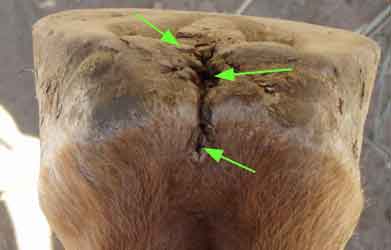


To the right, we see a foot battling severe deep central sulcus thrush. On the surface you don't see anything that screams thrush, or severe. But that crack shouldn't be there. Look above, see, no crack. The bacteria and fungus runs rampant in the frog undetected and then one day you wonder, HMM why is my horse so tender to hoof picking? His feet look okay....until you realize that crack isn't supposed to be there...and boy is it deep. The first time I stuck something in there during the course of treatment for Maxwell, I cringed. So did he.


My horse's cause of the thrush was due to the constant wrapping and exposure to moisture. It was kind of inevitable because it wasn't something I could change until wrapping was no longer required. Little did I know that the months I spent treating it conventionally could have been cut down to weeks if I had gone the cheaper, alternative route from the beginning.


My farrier at the time swore by Thrush Buster. I went through 3 bottles from August to Christmas. He had me putting it on every little blemish in Max's hoof wall and white line to help keep all the crud that can turn into anything, from getting through. It's been said that the Gentian Violet in the Thrush Buster has some medicinal effects on all things hoof microbial. I didn't discount his claims, and I applied the stuff religiously to both the clefts around the frog, any off looking spot of his hoof both sole and wall, and deep into that sulcus to try and eradicate the infection within. This stuff just wasn't cutting it. Not to mention, it's purple and purple sucks to get out of anything. 


The only reason I even tried No Thrush was because my local Tractor Supply doesn't carry Thrush Buster and I was out of any and all thrush treatments. The idea of a "dry" thrush treatment sounds great. It's one of the fundamentals of getting rid of thrush in the first place, removing all moisture. The idea is there, and I think even the formula is good, too, however, application is a little dodgy.  Powder doesn't sit well where you need it to on a dry surface. The moment Max put his foot down at least half of what I had just applied came flying out with it onto the concrete. 


I'm going to go out on a limb here and be truthful (seriously, I'm always truthful, I just used that line because it sounded good)....I had known about a potential "cure" for quite some time at this point, but I just wasn't buying what was being sold to me...The idea was there, the first-hand testimonials (my favorite reference on a product!) were there, but yet, I hadn't purchased the miracle cure...Why? Because my Tractor Supply only sold the HUGE quantity at $40 a box. Clearly that's not a frugal and effective way to treat thrush.......


HUH????? What the heck is this stuff???? Dry Cow Mastitis treatment???? If you've only ever delved in Horses, this might be foreign to you. Mastitis in cows is an inflammation of the udders often caused by an infection from various organisms. This nifty little tube (with a flexible long delivery tube on the end!) contains Cephaperin Benzathine which is a bactericidal that helps eradicate gram-positive and gram-negative organisms, giving it a broad range of working ability. Some genius realized that some of the organisms that cause thrush were also affected by this bactericidal and started squirting it on their horse's severe thrush. 


I wouldn't break out the Tomorrow at every sign of thrush, that's only going to decrease it's effectiveness over time, but for a stubborn case or a more severe infection in the case of deep central sulcus thrush, this medication is paramount. I kick myself for waiting so long to try it. My local Tractor Supply only sells this in a box, full of them. We all hope to never need a full box of this stuff to treat thrush, especially on a single horse. So I kept putting it off, until I took a quick stroll through the Cow aisle at my local non-tractor supply feed store and saw that they sold it by the tube! $2.99 later, and Maxwell's deep sulcus thrush is healing beautifully. I've actually gone back and bought two more tubes, because the problem isn't completely gone, but we're getting there and this stuff is showing MAD improvements over thrush remedies past. It's important to realize there is a similar product called "Today"....This is for the cow that is lactating and contains a different set of medications, if I had to guess, to keep the milk from being tainted with antibiotic type contaminants (speculating here, I'm not a dairy farmer nor do I play one on tv). I can't comment on it's effectiveness, and research online hasn't given me any result with it, so just stick with getting the "Tomorrow" medication, labeled for a DRY cow (a cow not producing milk). 


Moral of the story is....check the cow aisle before turning your back on a treatment. I didn't want to spend $40 on a box of this stuff when many traditional treatments are under $20. Turns out, at $2.99 I could have possibly completely eliminated this problem before it got to the point it did, had I done a wee bit more research and found that I could buy it by the tube somewhere else!  You live and learn! But the point here is, even if it were in fact $40, the amount of money I spent between 3 bottles of thrush buster and a bottle of No Thrush would have bought me that $40 box of Tomorrow anyway. 

I've still got my No Thrush and Thrush Buster in my groom bag. No thrush goes on after I've applied Tomorrow deeply into the crack. It does a nice job of holding the liquid in. I also poof it around Max's frog and over top of it to help keep everything dry, healthy and happy. Thrush Buster still gets applied to some funky looking spots as they come up, and all is right in the world of hooves around here. Seriously, save the $16 and go buy a tube of this stuff if you're battling something rank in the hoof. Save the traditional medications for maintenance treatments and  mild cases. Bring in the big guns like this when you're having trouble or have a bad case going on. You'll thank me. I promise!


Thursday, February 11, 2016

Messy Mooses

Is mooses a word? 

Life hacks!

We all love them. Some are stupid and don't really work, but others actually save us a lot of time, money, and energy in the process. Today I want to talk about something that SO many horse owners struggle with, but only those who actually do the dirty work probably relate to. Messy Stalls. Messy Horses. Disaster Zones. 

Maxwell isn't a particularly messy creature, but he DOES consume 15 gallons of water and roughly 20 pounds of hay, and 14 pounds of alfalfa pellets for the 12 hours that he is in his stall during the day. All that hay and all that water gotta go somewhere, right?! The sheer volume of manure makes his stall a bit difficult. He drinks a healthy 15 gallons of water per day, thanks to his alfalfa diet. This also causes an excess amount of urine, due to the extra protein he gets from the alfalfa. Pee city!!! I'm lucky because he does have a dedicated pee zone, and he's not much of a stall walker, so he doesn't do the toss and serve that many other geldings do in their stall. I clean stalls twice a week at Maxwell's barn, and clean his stall every single day I go out there. (yes, all the stalls are done every day, I'm just on the hook for it twice a week)... I'm a bit of a perfectionist with the stalls, and therefore it takes me a little bit longer to get them done than the average person. However I've implemented a couple of techniques which really help me breeze through stalls, and save a bit of money (shavings) in the process. 

The first piece of advice I have for a messy horse is to get to know their pattern. Figure out where they go (most have a preference and go in the same places each day). I can tell you where every horse in the barn enjoys peeing. It's important to identify the pee location prior to clean up, so that you don't accidentally scoop a pile of pee and mix it with clean shavings. Maxwell's stall can be a bit overwhelming sometimes, so I usually start by picking up all the obvious piles of manure. Max doesn't poop perfect poop balls (never has) but he has a well formed "pile" for each manure movement he makes. Sometimes they get rolled up underneath some fresh looking shavings and it requires some extra attention (more on that below). I remove all the big obvious piles I can find in the stall, while taking care to remove hay remnants that might be left-overs or mixed in with the shavings. 

Once we've removed as many obvious piles of crap that we can, I go to the pee spot. For most stalls (including Max's) I rake back the top layer of "fresh" shavings on top of the pee, since it soaks down and seemingly disappears (if you're bedded deep enough with an absorbent bedding). I take my time carefully removing all the urine before I perform the next steps. 

There is one particular horse at my barn who is a poop shuffling monster. He DOES poop perfect balls, so he really has no excuse, but we just can't seem to figure out what in the world he does to create such a mess in his stall. He doesn't stall walk, but it sure looks like he might based on the way his stall looks at the end of the day. For these difficult stalls where everything is mixed in, or once you've removed obvious piles and urine, this is the best thing I've done....BANKING. If you've ever taken up professional stall cleaning ( I don't recommend it), you've probably learned this neat little task before. I drag all the bedding away from a back wall of the stall to start. Then? Simply take a pitch fork full of shavings and kind of fling it against the wall. It's awkward at first, but once you have the flick of your wrist down, it's amazing. The shavings form a nice little mountain, and the poop rolls down the mountain to be collected at the base. It's one of the most gratifying things I do with my time, building those shaving mountains and watching poop roll down them and separate from the shavings so nicely for me. I continue until I've banked the entire stall. Sometimes you have to move down the wall, or pick another wall, depending on how deeply bedded the stall is. But it's SO worth it, especially if your horse poops everywhere, or you have a hard time leaving a stall with all those little specs of poop that somehow separate themselves from the rest of the pile. PLUS this gives you the opportunity to do a 'fluff and refresh' of the bedding. All the bedding gets turned over, and some fresh, unused bedding that built up along the sides of the stall is mixed into the tired bedding, prolonging it's overall life. 

The real life hack, though, is HOW you bed the stall. Every person has their way. I've tried to under bed, over bed, and tried different materials to bed with. Your preference might be different than that of mine or my barn owner's, but honestly, I think it comes down to the individual horse and it's specific bathroom habits (and health needs in some cases). 

Probably the 4 most notable types of bedding for a horse's stall include Fine Flake Shavings, Flake Shavings, Pelletized Bedding, and Straw.


Small flake shavings are my top pick. Easier to sort through than the larger flakes, they make stall cleaning go a little bit quicker. I have a love-hate relationship with Tractor Supply's brand, as the consistency of the flakes varies by batch, as does the weight of the bag. Sometimes Max only requires two bags in a 12x12 to achieve sufficient bedding coverage, and sometimes it takes 4 bags. It's very inconsistent. The reason I choose to stick with this brand, is that they've done nothing to offend me to the point of NOT using them, especially when they're averaging $1.00-1.50 less than any other brand of fine flake shavings in the area. 


Flake, or "Large Flake" shavings are my pet peeve. I've actually been recommended them by more than one vet and farrier, but I just can't bring myself to bed my horse's stall with them. Much harder to sort between flake and poop, these suckers get my blood pressure up every time I clean a stall bedded with them. The vet makes a great point, however, that the larger flake bedding provides the least amount of dust. If your horse has respiratory issues, or you worry about the dustiness of your bedding, larger flake bedding might be an option for you. Two past farriers also recommended large flake shavings, especially on top of mats, because there is more absorption flake per flake verses that of fine flake or 'sawdust' type shavings. I totally get that. It's super important to not allow your horse to stand in his urine all day, and if bigger flakes help that, by all means, use them. I just cannot stand them, and go through them MUCH MUCH quicker than I otherwise would. They have their place, but their place is NOT in Max's stall!


Pelletized bedding is my second favorite choice. It used to be my first, but there are two reasons why it makes second on my list. The first reason is just the ease of use. To use this bedding *properly*, it requires a wheel barrow (or dumping in the stall if you fancy all that) and water. I put one bag in at a time, soak the appropriate amount of water with said bag, dump into stall, spread, and repeat. 4 times. It takes at LEAST 15 minutes for me to bed each stall using 4 bags of pelletized bedding. That being said, I actually really LOVE this bedding when it has been put down properly. It does a phenomenal job of absorbing moisture while maintaining its integrity a lot longer than that of traditional flake shavings. The kicker, though, is making sure you turn the bedding every day. Some people don't do this, and I will never understand why, but if you don't turn this bedding and actually MIX the messier portions with the clean, it won't work out for you very well. It's designed to hold a little bit of 'yuck' and when you mix it into the clean stuff, it's like magic. The reason this gets another mark off, though, is again thanks to my farrier. Because this stuff does such a phenomenal job of absorbing moisture, it also holds that moisture for a lot longer before becoming unusable. This means, that while the bedding may not look actively wet, it's got a lot of 'wet' inside, and a horse standing in it for an extended period of time could suffer an adverse reaction via the hoof. I found this to be true with my own horse, and once I removed the pelleted bedding from his stall and swapped back to fine flake, his feet held up a LOT more, and a LOT less moisture damage was seen in his feet at each visit. 


Straw is probably the oldest type of bedding. I've actually never used it myself, because I loathe it, but it does have its place, and is still commonly used in places like race tracks. While it absorbs quite a bit, I can't even imagine trying to sift through all that to get those magical poop balls out. Not to mention, how do you identify soiled straw (urine soaked) from not? It's all yellow is it not? I dunno. I hate it. And it drives me insane when Maxwell is a bit low on shavings, and makes it a point to drag his hay to his urine spot to achieve the same goal as straw bedding would serve...Icky. Straw is also a great choice for a low dust option, however, for horses who require special attention to that. It's also SO nice to take a nap in.


The most exciting part about this post is coming now. We've explored that magical banking maneuver to breeze through stall cleaning....but what about those messy misters (and some misses, too believe it or not!) that mix it all together into a chopped salad for you to pick through? This is something my barn owner started doing with her two draft horses, and I've adopted the idea, modified it a bit, and implemented it in my own horse's stall last week. Take two of the bests, and make the magnificent, no? In my barn owner's situation, she takes two bags of pelletized bedding and spreads it (unsoaked) around her horses' stalls as a base. Then she'll take 4 bags of fine flake shavings and place that on top. It works really well for those two horses, and seems to keep her super messy (that poop shuffling monster I spoke of earlier) horse's stall fresh for ALMOST a week. This works well for her guys because they're huge, with dinner plate sized feet. The little pelletized bedding pieces (look like pelleted feed, maybe a bit thicker) gets crushed under their feet, and becomes a wonderful absorbing base layer for the stall. I bed Maxwell's stall a little bit differently, and it's something you guys should consider as well:

For Max, in a 12x12 stall on mats, I lightly soaked the pelletized bedding in the wheel barrow first. The reason I soak my pellets instead of just tossing them in like my barn owner does for her big guys, is because I have a Thoroughbred. A Thoroughbred with sensitive soles. I don't want to make him walk around on pokey pellets all the time. I also do it because I think the pellets last a bit longer when they've been expanded (believe it or not). I spread ONE bag of pelletized bedding as the base layer on the mats, taking extra care to ensure that a sufficient amount covers the areas where Maxwell is known to pee. Then I take 2-4 bags of fine flake shavings and place them on top. 2-4 because it depends on the "volume" of the bags. This past Sunday I did 1 bag of pellets and 2 bags of fine flake shavings. By Tuesday, the stall still had that "fresh shavings" look to it, and smelled great too. I still do my banking movements to sort through the shavings, allowing the pelleted (which looks more like saw dust once it's expanded, or crushed in the case of the draft horses) bedding and fine flake shavings to mix. When I redistributed the shavings around the stall (every stall needs the shavings flipped and fluffed, c'mon!) it STILL had that wonderful fresh shavings look. Today is Thursday, and I'll be interested to see how the stall cleans up tonight. Usually I can get away with 2-4 bags of shavings a week, the stall needing to be re-bedded by Saturday or Sunday most weeks. We're already ahead of the curve as of Tuesday, so I'm hopeful we might get a week and a half out of these suckers....I'll be sure to clue you all in later on. But seriously, this technique really does help absorb excess urine that otherwise ruins countless shavings, and leaves many horses standing in urine.

What are your stall bedding habits? What's your favorite technique to cleaning a stall?


Wednesday, February 10, 2016

Take it Easy

The scary struggles and triumphs of an amateur...

An amateur doing it on their own is a whole lot scarier.....but here I am! I'm not really doing it all alone. I have some special people supporting me and helping me along the way. Anyhow, things have been going just wonderful for me and Maxwell lately.

I recently saw one of those Facebook meme type things....it was a photo of a horse and the quote said "Wining on a 'made' horse will never be as satisfying as winning on one you made yourself"..... that quote has been my mantra since the day Maxwell came home to me. I finally had my shot at a horse built for me that had a blank slate and was ready to learn a new career. I was going to make this horse. I am making this horse.

I don't have a big name trainer. Right now all I have is the support of some pretty amazing people, no practicing trainer at all. But for some reason, we're going better than ever before. Over the summer we had a trainer and we weren't going nearly as well as we are now. I'm so excited to see the horse I "make" of Maxwell.

One at a time we check things off his long list of annoyances, complaints, or things that just don't work for him. One at a time things just start to come together better and better. Widen the saddle, and suddenly my horse moves off of my leg strides better than previous. Remove the bit from the equation (at least temporarily) and I have a horse that works quietly, without tension and stress in his mouth and jaw. Better nutritional options leave him feeling more comfortable overall. Always always take an extra moment to really listen to your horse. They don't lie, they're actually quite clear when they have something to say. You just need to listen.
                             
 I'm really falling in love with my horse all over again. He's still a green bean. He still has green horse moments, but he's becoming such a wonderful, willing partner to me. This week we started back to 4-times-a-week rides. The early darkness gave him a well deserved Winter Vacation, where he only worked 2 times a week (if he was lucky!), but I was able to show up, throw tack on, and get a productive 35 minute ride in yesterday after work. Tomorrow we'll try again. It's only going to get lighter and lighter as we get closer to daylight savings time. I am so very excited to get this big geek back into shape. He's working more correctly than ever, so I'm interested to see what a big muscular animal I can build this summer.

And then there are horse shows. Maybe Max and I will make a debut in the ring at some point this year. I'll let him decide. Many OTTB's that have been retired from racing for a year are further ahead than he is in training, already showing and competing. I chose to take things extremely slow with Max. There's no deadline. There's no rush. He's a sensible, hard working animal, but he deserves to move slowly into his new career. He comes to me with 6 years of racing wear and tear. The least I can do is allow his body a break, and to slowly build it up for the type of work expected of him now. So please, don't feel "bad" for us because we haven't made it to a show yet. This is all apart of our master plan. Slow and steady wins us the race....obviously that mantra doesn't work for a race horse, but surly it can work for a retired racehorse. He is never asked to do more than he is capable of (even if he says otherwise). I want to spend my time perfecting my horse in the ring, on the trails, and in every situation I can think to put him in. I've ridden him in a downpour, in 100 degree heat, in 30mph winds, in the frigid Florida cold (hehehe) and many questionable 'spook' opportunities in between including slamming gates, screaming children, falling palm fronds, gunshots, motorbikes, etc. I'm creating a solid citizen. We'll walk into the ring for the green division, but nowhere in our performance will you actually see 'green'. This is my vision for this horse. To be completely prepared for anything he's ever asked to do. No surprises. Honesty is huge to me, so of course I am always honest with my horse, as well. I'm 100% dedicated to this beast!


Thursday, February 4, 2016

Guts

Sorry about the lack of blog posts last week, and the first half of this week. I've been dealing with some medical things that have taken me away from this blog! But here I am! I have caught up and found some time to put some effort into an important post today. Gut health!

I was going to break into song, you know, that song by Stevie Wonder..."Cause I've got an upset stomach..." but it's about a broken heart, not due to gut issues, so I refrained, mostly for your sake!

Okay, so Maxwell has been on his Abprazole (omeprazole) stomach ulcer treatment for 6 days now. Obviously we're hardly a week into treatment, but I've decided to get a jump start on better supporting his stomach once the treatment is complete, to hopefully eliminate the risk of developing the ulcers once again. I realize some horses are just more susceptible, regardless of dietary support, but before I label my horse a lost cause on ulcers, I want to ensure I'm doing all I can to help his stomach out. His diet is already extremely compatible with an ulcer horse's needs, so we're good to go on that front.

Maxwell came to me on a great acid buffer called U-Gard. It is an extremely cost effective supplement to create a neutral PH in the horse's stomach, not to mention how highly rated and highly spoken of, it is. I haven't changed my views on this supplement; if you're looking for something that will buffer acid in the stomach, this is an amazing product. Increased magnesium and calcium are also beneficial. However, Maxwell recently underwent a diet overhaul and his diet is now extremely high in calcium. It's partly the calcium in this product (and in things like Alfalfa) that cause the buffering effect on the stomach, so because Maxwell is consuming 13 pounds of alfalfa per day, I needed to re-evaluate my stomach ulcer support medications and eliminate any extra calcium.

Before I go any further, I want to also mention the hind gut. I've posted about it before, and I'm sure I'll do it again after this post, but the hind gut is so very often overlooked. Those who have done their research on gastric ulcers realize that if their horse wasn't already suffering from colonic ulcers in addition to the gastric ulcers that they were most concerned about, almost certainly after treatment with omeprazole you can expect at the very least some colonic distress. Maxwell has been on SmartDigest Ultra pellets for several months now, following a 2 month course of Succeed paste. His hind gut has greatly improved from the time before Succeed until now, as has his weight. I'm a little nervous to see how his hind gut responds to 30 days of omeprazole followed by a wean-off period, but I'm confident that SmartDigest Ultra will support better than nothing at all.

The logical thing to do in my situation, needing a stomach support supplement that works well with my hind gut support supplement, would be to put Maxwell on (a great but expensive) product from Smartpak called SmartGI Ultra pellets which essentially combines Smartpak's stomach ulcer support supplement SmartGut Ultra with their hind gut support supplement SmartDigest Ultra. At a whopping $95 a month, I dived into trying to find a more cost effective alternative. I needed to find something that had a more supportive ingredients list than the U-Gard, at a cost effective price, that complimented the SmartDigest Ultra that is currently being fed. So research I did, and this is what I've come up with as something to try: G.U.T by Uckele

G.U.T has a lot of the supportive ingredients that we read about over and over again on various ulcer-based websites. It doesn't have them in the same quantity per dose as say, SmartGut Ultra, but it's also less than half the cost. I would consider upgrading to SmartGI Ultra to simplify my supplement feeding, IF and ONLY if a stronger concentration of these ingredients seems warranted, after a fair trial on the G.U.T.

I'm not here to explain the reasons why these ingredients are important to gut health, that's something I think every person interested benefits from researching on their own. Smartpak does offer a basic oversight of many popular ingredients in their offered supplements, found HERE, however I do still recommend further researching to better educate yourself before you make any decision on the supplement you are choosing.

I have taken the liberty of regenerating the comparison chart on Smartpak so that it can be posted here for my readers to see. Please note all nutritional facts listed here are courtesy of Smartpak.

This chart reflects the similarities and differences between my current choice for stomach support, and my NEW choice for stomach support. Remember, I have nothing against U-Gard being a very cost effective way to buffer acid, but in my horse's current dietary case, more calcium is NOT warranted, and I was looking for further support. Literally the only downside I can see as an outsider who hasn't yet tried this product, is that G.U.T is only offered in powder form from Smartpak. I have learned they do in fact make a pellet, at a higher cost, direct from Uckele. I'll consider that version only if Max decides this powder is no good.

As you can see, G.U.T offers a much more powerful punch in the fight against stomach ulceration, than does that of U-Gard. Remember, I don't necessarily want an antacid in my horse's everyday diet. The purpose of antacids and proton pump inhibitors are to decrease (or eliminate) the acid in a stomach. Acid is important for proper digestion in a health horse with a healthy gut. Once the treatment period with omeprazole is complete, I don't want to inhibit all acid production in Maxwell's stomach. The calcium and magnesium in U-Gard are what create the buffer in a horse's stomach, so in Maxwell's case, the large quantity of Calcium he consumes daily via Alfalfa would far surpass that of a supplement containing the same. I cannot yet comment on it's efficacy, as I've just added it to my SmartPak's and won't receive the first month's supply until February 15th, but I will be sure to report back both on how it's working, and how Abler's Abprazole has done for Maxwell's treatment.

My second chart is a just for funsies one. I placed G.U.T side by side with SmartDigest Ultra. While SmartDigest Ultra is marketed as a digestive and colon aid (hind gut), some people might get confused and assume they are supporting their horse's stomach as well. This isn't the case unless you're feeding that combo supplement I mentioned earlier on, or some other combination of supplements. I placed these supplements side by side to ensure I wasn't missing something or repeating ingredients and wasting money.

It's the little things in life that get me most excited. This happens to be one. Look at how beautifully these two products compliment one another. What one lacks, the other makes up for. All for $2.40 a day, or roughly $70 a month. That's a great savings compared to SmartGI Ultra, which is currently $95 a month. Again, I realize there are more potent quantities of some of these beneficial ingredients in that product, however not every horse requires such a large dose, and obviously not everyone can handle a $95 a month supplement. $70 is way more reasonable, and leaves me the $25 a month I need to support my horse's joints with a product not offered by Smartpak.

Of course, I've not put this supplement into use, but I wanted to share some of it's information and I hope if you're as curious as I, that you stop back here to see my thoughts on it in a month or two, once Omeprazole treatment is over, and these products alone are working on my horse's digestive system.

What are your thoughts? What do you use to support your horse's gastrointestinal system?


Wednesday, January 27, 2016

My quick Review of Equiflex Sleeves

Equiflex Sleeves


 At first glance, I thought these sleeves were something I just HAD to have. I spent a LONG time hemming and hawing over whether or not to spend the $45 on a pair. I had heard a couple of positive reviews of the product, a couple of people who were indifferent, and some who would call these glorified compression socks.

Around the holidays I won a free pair (Thanks Buckeye Nutrition!). Probably the only way I was ever going to put hands on these and use them, because I have a very hard time deciding what to spend money on and what not to. (have you picked up on  that yet??!) I got the size appropriate for Maxwell's hind legs, as his ankles are a bit larger in the back, and he tends to stock up back there more than up front. As you click through their site, they make a couple of really great points, things that really convince you that this product is a miracle for those who don't want to rely on anyone else to wrap their horse, or the inconvenience of unwrapping. I was really looking for these sleeves to give a bit of support to my horse's tired tendons, his slightly long pasterns, and his creaky ankles after a strenuous ride. A replacement for traditional standing wraps and no bows or quilts.

Applying the sleeves seemed like it would be a little bit tricky. You're supposed to apply the included plastic bag over the hoof, and pull the sleeve up over the hoof, and then slide it back down into place. In theory this sounds easy, and overall it was much easier to apply the sleeves than I thought it was going to be. My horse isn't a fan of plastic bags, but with a little bit of help the process was pretty straightforward and they were on in under 20 seconds.

Maxwell and his Auntie were twinsies 


They appeared to fit Maxwell's hind legs well and I placed him back in his stall. The next day it was time to remove the sleeves...

Removal was not the walk in the park that applying was. After a lot of fumbling around and loss of patience, I just pulled the suckers off without much regard. I got so fed up with them, that I balled them up and placed them in the envelop they were delivered in, where they happen to still remain. I can't comment on the durability, because well, I was rough on them and haven't looked at them since.

The results: I haven't the slightest clue what these actually did. His ankles were no smaller, and tendons no colder and tighter than when I do nothing for the legs after a ride. I was seriously disappointed with this product upon initial use. I can't comment on their effectiveness for stocking up, because Maxwell does not actively stock up after every ride. I suppose I'll keep them around for a while, to see if we get an episode of stocking up that I can test these out on, but overall, I'm SO thankful I received these as a prize and didn't waste $45 on them. I think compression therapy has it's place, but the claims of support for tired tendons after a ride leaves me baffled. I'm not sure they provided any relief, support, or anything of the matter to the tendons, fetlocks, or pasterns. I will give them a fair shot, when stocking up becomes an issue in Summer (heat, humidity, wet weather, staying stalled for a 24 hour period if it's really bad...etc tend to be when I see this problem), but in the mean time, I don't recommend these. I will come back and give an update, especially if they do some magic on a stocked up leg. I'm willing to dish these babies out to whomever has a horse Max's size that would like to try them and see if they make a difference for a severe case or chronic stocking up issue. It could be that these are more for treating symptoms rather than prevention, even though the website claims both. (go figure!)

Perhaps I should bring them home and unball them, wash them, and place them on the shelf for later.

It's confirmed that I do in fact think it better to invest in  2 pairs of Back on Track Quick wraps versus these things, that's for sure!

**also** please direct your attention to the right side of my blog! There should be an option to subscribe to my blog! You can either enter an email address and get an update any time I post a new post, or you can join bloglovin and follow me that way!! Alternately, you can follow me through Blogger's integrated system as well! Thanks!!!


Blogging for Apples

Personal Experience.

It comes second only to proven facts and studies in my list of things that matter the most when considering a new product or item.

I would rather read a first-hand account of a product from a real person, unpaid by any company, who ordered the product on their own free will, than spend an hour reading materials regarding the product on it's website.

This leads me to what I want to talk about today. I've pulled up 3 really interesting blogs, which I happen to follow, that contain reviews/overviews about products. It's my intention to break down what I like and dislike about each review, and to also give a little bit of insight into the products, if I have something to offer up on them. All three blog posts/reviews come from respectable places, and it's my intention to only build off of the work they've already done, or to give my thoughts on the work they have done.


>>Equine Nutrition: Actiflex 4000 Inside & Out<<


This blog in general is extremely helpful to people like myself, who obsess over horse nutrition and supplementation. Hannah does a remarkable job in ALL of her posts explaining the scientific facts in each part of a product she might be discussing. Her informational tables are WONDERFUL as well. I really recommend clicking around her blog. If she weren't busy in the Army right now, I'd be getting on her to update the blog, she has GREAT content!

This particular post convinced me to switch my horse to Actiflex 4000. At the time I had my gorgeous dappled buckskin pony Bella, and she was getting 10,000 mg MSM per day. Her work load was increasing, and I felt it necessary to up the support I offered her. One look at the presentation of ingredients and facts on this blog, and I was pretty much sold.

The blogger has a clean, streamlined approach to her blog. She almost always provides some sort of informational table to go along with her product review. This helps paint a better picture for those of us who are visual, with regards to the contents, amounts, and price. She takes all the hard work out of researching similar popular products. I am eternally grateful for the time she has spent making such tables. Her presentation of the ingredients and their purpose gets quite scientific, but for someone like me, who wants to know the why along with the what, it's a perfect balance. At the end of the post she goes on to give her first hand experience with her OTTB and this product. As if I weren't sold enough halfway through her post, the testimonial to the product is actually what convinced me to give it a try. I feel that personal accounts and opinions of things help me form a more balanced, realistic idea about each item I question. I applaud Hannah for the superb job she does presenting the facts and her own opinions.

I have successfully used this supplement for a year and a half, now on two different horses, with SUPERB results. LOVE this stuff.

>>Tofino Tack: Back on Track Royal Boots Review<<


I'm new to this blog, and I'm fairly certain that the blogger is somewhere in the UK. Thankfully, there are a handful of items which are also available in the United States that I am familiar with. The Back on Track Royal Boots have been a questionable item for me to try out for some time. (as have many other BOT products) I really like the details provided on this blog post regarding this item. The blogger does a wonderful job of providing the company's information about the product, and then quickly goes into their first impressions with the items. I was very happy to see that her review was NOT all rainbows and sunshine. She had valid cons to this product which helped me become a more informed reader, and actually backed me up a few steps in my thoughts to purchase. Her account of the durability of the internal structures of the boots was very honest, with photographic evidence of the durability or lack thereof. It's very important in making a decision on an item, particularly if you're like me, and like to remain as frugal as you can in this industry. She saved me a lot of money when I would have expected the boots to hold up as others typically do. Overall, she still loves them, and if you have the money to spend, recommends them because in her personal situation, the benefits and therapeutic qualities outweighed the lack of durability. Another nicely put together blog post, and overall a wonderful blog.

>>Savvy Horsewoman: 5 Best Selling Helmets Under $80<<


This blog is overwhelming, in a good way. Clearly the Savvy Horsewoman did something right, because her blog is jam packed full of content, advertisements, etc. This is probably what many bloggers strive to achieve. There is a lot of great information to be had here.

For this particular blog post, the blogger introduces the 5 best selling helmets under $80. The idea is grand. It's right in my niche of being frugal and functional. I actually owned one of the aforementioned helmets for my everyday schooler (The Tipperary Sportage in Matte Black). However I was disappointed. I LOVE the blog, please don't get me wrong, but this post is lacking so much. Where is the personal touch? I see a small blurb at the beginning about how helmets and budgets are important to the blogger, but no mention on anything relating to these helmets directly. Where is that personal touch that helps the reader make a decision? The blogger links off to amazon reviews and star ratings, but puts no personal effort into any of the items. I don't fault the writer, as you can tell, there is a LOT of content going on around the entire blog, but sometimes a reader is looking for a more intimate look at things. It's helpful to relate to your readers, wouldn't you all agree? I do have to put in a plug for the tipperary sportage, a GREAT economical schooling helmet that makes my head not look as big as my old IRH did!


I'm not here to criticize anyone's writing, but I am here to give praise where praise is due! Each one of these blogs provided information to us, the consumer, to do with what we will. Three very different ways to present useful information to us, the fellow consumer.

What do you look for in a blog review or even an opinion piece? What aspects draw you in, and what points help you make an informed decision about what the blogger is writing about?


Friday, January 22, 2016

Frugal Friday: One is the loneliest number that you'll ever do...

If you haven't caught onto my ridiculous pattern here lately, you're an idiot.

Let me try that again. If you haven't caught on to my ridiculous pattern here lately, you're still an appreciated reader of my blog, but my goodness, take a look back and try to figure it out.


(the pattern is naming posts after/mentioning music in each post)

It's a fun way for me to stay motivated. I ALWAYS have something playing in my brain, even when it's dead silent. When I think of what I want to talk about here, songs often pop into my head, and it's nice to have a song to jam out to while I write, that has some sort of substance pertaining to what I'm writing. Today is no exception, especially because it's the second installment of Frugal Friday!


One may be the loneliest number, but that is only to our benefit when we're talking about spending money. You know, that paper and coin that makes the world go round for most of us... Yeah. Spending $1 versus $5 is enough for many to break out in song, am I right? Today we're going to talk about the various horsey-related items you can pick up at the Dollar Tree. A long while back, I introduced you guys to some grooming products that could be purchased at the Dollar Tree (see HERE) and I intend to mention them again here, too, so sit tight if you can remember that far back and realize I've repeated an item or two.


Fake Flowers
I haven't yet gotten around to building flower boxes for our jumps at the farm, but it's always in the back of my head, that when the time comes, we'll go to the Dollar Tree to pick up fake flowers for them.


Storage Containers and Bins
These are a no-brainer. I use a variety of these for everything from bath buckets, tack trunk organizers, to feed room storage. There are no shortage of uses for these various containers as it pertains to horses (OR home!)


Over the Door Hooks
These are awesome. If you're looking for a cheap and easy way to add storage to your stall front, these are a great way to go without damaging the stall fronts or screwing anything in anywhere (great for shows, too!). They work for most stalls that have something to hook onto. I have one similar to this which houses my fly spray, spare lead rope and halter, and Maxwell's flymask. I have another similar idea to this, but instead of 4 hooks on the end, it's a basket. I'm going to be bringing that out to the farm to add to his stall front as well, so I can put things like a brush, hoof pick, and any other "close by essentials" I might want in it. It's important to note that I have not seen the basket version at the Dollar Tree, just this type, in both metal and plastic. But I wanted to throw that basket idea out there for anyone who has one laying around or has seen them elsewhere!  These are awesome.

 Lingerie Bags

These little babies are the bee's knees, and I've actually been on quite a hunt to find them lately. Like many of their hot ticket items, the Dollar Store runs out of these like hotcakes. Got to be quick. They're amazing for washing polo wraps and boots in the washer. Gone forever is the mess of untangling polos or pulling velcro boots apart. These little babies are worth every penny in that dollar.

Pharmaceuticals
There are MANY useful items found in the medications aisle of your local Dollar Tree. Ever hear of the magical Scratches cure? Triple Antibiotic Ointment, Athletes Foot Cream, and Diaper Rash Cream. All three can be bought here. It's important to pay attention to the amount you get, however. I've found that if you're just needing to mix up a small batch, or use some of these items sparingly, it's worth the cost. But if you find yourself needing to mix more than one batch up, larger tubes found at bigger stores like Walmart or Target will likely yield you a better price per oz. Other things you can find in this aisle that may be of use to you include: epsom salts, witch hazel, evergreen rubbing alcohol, blue muscle rub gel (cheap mild liniment rub in a pinch!), baby diapers (in a variety of sizes none the less!), antacids for a quick tummy buffer, gauze pads & rolls for would care, etc. I'm sure I'm forgetting something in these aisles. I spend a lot of time here, and can't even recall all the good purchases made here!

Hair Care
You name it, and they probably have some cheap version of it. I never ever ever buy "horse" specific conditioner. White Rain Hibiscus Coconut Moisture Conditioner is the bomb! Typically I do use a horse shampoo, but I'm known to break out the baby shampoo as well, especially for faces, manes and tails. It leaves everything SOFT, SHINY, and NOT crying from the burning suds, not to mention a bottle can be found at your Dollar Tree! Other helpful items include coconut hair product, olive oil detangler and sheen sprays, black (or clear) braiding size rubber bands, brushes easily used for manes and tails, and hair sprays/gels to tame fly-aways as needed. 


CleaningI'm going to lump a couple of aisles together in this section for the sake of the fact that they're scattered throughout the back corner of my local store. Car wash sponges (in the car aisle...) are GREAT bath sponges. I have actually never purchased a sponge marketed FOR horses. Only the car sponges. They're cheap, they last, and, well, they're cheap, enough said. Dawn dish soap! Well all know what magical blue stuff that really is. They usually have the concentrate and an average sized bottle. Obviously if you go through this stuff like crazy, a larger bottle from the big box stores is a better bet. Various cloths/rags always find their usefulness around the farm. Sponges and scrubby brushes, too! I've even seen oxyclean in the little tub. It's trial/sample size, only a couple 'loads' worth, however I don't believe a gray horse's tail or manure stains require an entire washer load's worth....but who knows. Vinegar can be found in the food aisles, usually. I don't purchase mine here, because I require a gallon, and they usually only have a liter bottle. Bleach! Don't forget bleach! Always needed! It usually goes quick at my local store because Walmart charges $2.78 for the same gallon. 


Bags, Containers, Etc
If you have a needy creature of a horse like mine, you've probably been in a situation where you basically need to craft a home made version of smartpaks. Dollar Tree carries many different sized tupperware containers as well as a great variety of disposable options. (please see the photo that accompanies this. I LOVE those containers) I also like to mention they carry a variety of sizes and styles of plastic baggies, good for anything from grain prep to soaking feet.


I feel like I'm barely skimming the surface here when it comes to useful items for horses at the Dollar Tree. What are your favorite finds at this, or any other local discount store for your barn or horses?

Good luck making 1 your lonely number at the register after spending an hour at the Dollar Tree with HORSES on the mind!!!